




Api Himal—the crown jewel of Sudurpashchim Province. The highest peak of the region, Api (7,132 meters), is a steep mountain of smooth rock faces, constantly exposed to sunlight. As a result, snow does not accumulate here; it melts quickly. In contrast, the surrounding mountains that stand like a ring around Api are perpetually snowclad.
Api’s East–South Base Camp (3,900 meters) lies in Ward No. 1 of Api Himal Rural Municipality in Darchula district. Api is considered a technical mountain; climbing it is not easy. History records that on 10 May 1960, the first successful ascent of Api was made from its northwest base camp by Japanese climber Katsutoshi Hirabayashi, along with Nepali climber Gyaltsen Norbu Sherpa.
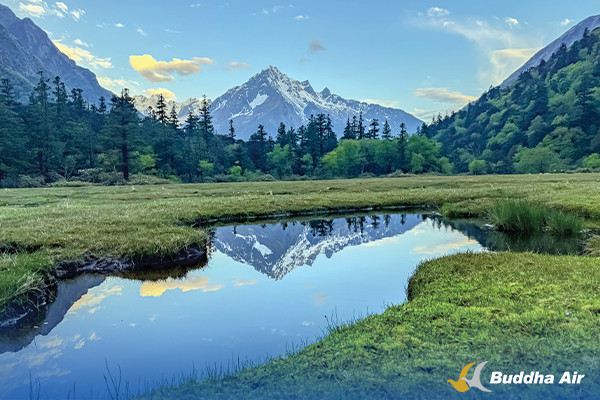
Although the mountain is difficult to climb, those with physical fitness, determination, time, and financial means can attempt the ascent. Reaching the Api Base Camp, however, offers an accessible yet thrilling trekking experience. The region’s extraordinary natural beauty, Himalayan lifestyle, and the culture of Maldesh leave trekkers deeply enchanted.
Api Himal falls within the Api Nampa Conservation Area, which the government declared a protected area on 12 July 2010, covering 1,903 square kilometers of Darchula district. From a biodiversity perspective, the Api region is rich. Wildlife found here includes the snow leopard, red panda, deer, goral, jharal (Himalayan tahr), bear, and blue sheep. Birds such as the Himalayan monal (danphe) and other pheasant species are also found here, along with diverse flora and forest species.
The Api region is home to Khas-Chhetri, Sauka, and Dalit communities.
Api Himal Rural Municipality has identified Api Himal as its principal tourism product and is actively working to develop tourism. The municipality covers an area of 613.95 square kilometers and has a population of 6,798, according to the 2021 census. The residents practice Hinduism, Masto, and Bon religions.
The municipal administrative office is located in Khandeshwari. The primary sources of local income are medicinal herbs, agriculture, and foreign employment. With wise infrastructure development and effective marketing, tourism could become the economic backbone of the region.
Only in the last three years has Api Base Camp begun to see regular trekking activity. Annually, around 5,000 Nepali and about 250 foreign tourists reach the base camp.
Looking back, the tourism potential of Api and the wider region came into focus around 2006 with the launch of the “Beautiful Sudurpashchim” campaign under the leadership of entrepreneur Gopi Hamal, now Mayor of Dhangadhi Sub-Metropolitan City. Since then, tourism experts such as Amar Bahadur Shahi, Krishna Bahadur Mahara, and Parmananda Bhandari have been actively promoting tourism in the area.
The key figure behind the rise in tourist movement to Api Base Camp is Bhakta Singh Thekare Bohara, Chairperson of Api Himal Rural Municipality. Since assuming leadership, he has pursued aggressive development and promotion initiatives.
Tourists are required to pay entry fees to enter the protected area. Nepali visitors pay NPR 100, and foreigners pay NPR 2,000, to the Api Nampa office. Additionally, the rural municipality charges NPR 50 for Nepalis, NPR 200 for Indians, and NPR 300 for visitors of other nationalities.
The municipality operates an information center at Makarigad, the gateway to Api Base Camp. As trained local guides are available in the village, visitors can contact the center for assistance.
The Api trek can be completed in 9 days from Kathmandu. The trail connecting Api to Saipal Base Camp is currently under construction.
From Api Base Camp, trekkers cross Patarasi Pass (4,698 meters), Dubey Pass (4,583 meters), and Nilkatti Pass (4,930 meters) to reach a place known as Naya Odar. From there, via Kanda, the route leads to Saipal Base Camp.
After reaching the Api Base Camp, one must return for a day to Khaykot, then proceed via Thumti and Kshetti villages to reach Saipal. The Department of Tourism has been investing in developing this trekking route. Once completed, foreign trekkers will be able to undertake journeys of up to 25 days. In the coming years, an increase in foreign tourists to Api is expected. Tourism prospects of Api are beginning to shine.
The Torchbearer of Api
The credit for bringing tourists to Api largely goes to Bhakta Singh Thekare Bohara, Chairperson of Api Himal Rural Municipality. After assuming leadership, he prioritized tourism, partnering with the Api Nampa Conservation Area, the Department of Tourism, the Nepal Tourism Board, UNDP, and other organizations to bring tourism projects to the village.
Under his leadership, trekking trails have been built and improved, tourist maps published, and homestays, teahouses, and hotels constructed. Villagers have also received basic tourism training.
To promote tourism, Api Visit Week was organized in April 2023, and Api Visit Year was launched in October 2023, attracting domestic tourists. He frequently brings tourism experts, journalists, and tourism entrepreneurs to Api.
“The organic environment here wins everyone’s heart,” says the 40-year-old Chairperson Bohara. “We can achieve prosperity through tourism.” Energetic and highly collaborative, he has played an exemplary role in rural tourism. This year, the Ministry of Culture, Tourism, and Civil Aviation recognized Api Himal Rural Municipality as the best municipality nationwide for its outstanding work.
Best wishes to Bhakta Singh Thekare Bohara in his campaign to make the Api region a model tourism destination. Contact: 9868014567
Api Base Camp
To properly explore the base camp, at least 2 days are required. The mountains, alpine lakes, and the origin of the Chameliya River are the main attractions here.
A glacial valley encircled by mountains on all sides. From here, snow peaks are visible in a full 360-degree panorama. Dozens of mountains, including Api, stand along vast alpine meadows (patans). At sunrise and sunset, they glow in shades of gold.
From the base camp (3,900 meters), one can see Api Himal (7,132 meters), Api West (7,100 meters), Nampa I (6,929 meters), Nampa II (6,700 meters), Nampa South (6,580 meters), Kayakor, Babai (6,808 meters), Jethibahurani (6,850 meters), and Lhayul (6,397 meters), among other peaks.
The Chameliya (Chaulani) River originates at the foothills of Api. From the hotel area at base camp, a onehour walk leads to the origin of the Chameliya, while a two-and-a-half-hour trek reaches Ringdepani Lake (4,300 meters) at the base of Api and Lhayul Himal. This lake has been named Parvati Kund. Similarly, at the base of Babai Peak lies the stunning Kalidhunga Lake (4,200 meters), which can be reached on foot in about 2.5 hours.
The base camp remains cold at all times. In the vast meadows here lies Pilkan Daha (the trembling marshland). During the monsoon, the area becomes exceptionally delightful. Ground flowers bloom across the meadows. Sheep and horses graze freely. Seasonal monsoon lakes form, reflecting the shadows of mountains, people, and animals alike.
The Api is believed to be the abode of Lord Shiva. Local belief holds that the Chameliya River originates from his matted locks. For this reason, a Shiva temple has been built near the river’s origin.
In the meadows and alpine slopes around the base camp, the medicinal herb Yarsagumba is found. During the monsoon, the area resembles a fair, with crowds gathering to collect it. From Baisakh to Asar, people stay in the meadows to harvest yarsagumba.
The Api trek can be undertaken throughout the year. There are two teahouses at the base camp, offering food and accommodation facilities.
Most trekkers reach the base camp from Makarigad via Ghusa and Siti and return the same way. We have promoted the concept of a round trek. Now, instead of retracing the same route, one can return from the base camp via Khaykot, Lumcha, and Khandeshwari to Makarigad. Alternatively, one can go via Khandeshwari and return via Ghusa.
Pokhar Singh Lothyal Chairperson,
Ward No. 1, Api Himal Rural Municipality
Contact: 9868810761
Maldesh
In village homestays, one can enjoy local cuisine along with the fragrance of Maldeshi culture.
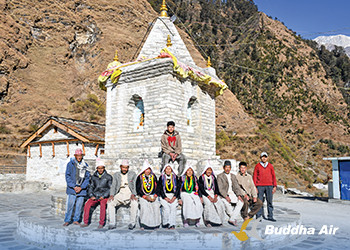
Maldesh literally means “the upper land.” The former Khandeshwari VDC is known as Maldesh. The geography from Makarigad to Kshetti village constitutes Maldesh. A local saying goes: “There is no flesh above the nail, and no village above Kshetti.” Kshetti village also serves as the gateway to Saipal Base Camp and Surma Sarovar.
The language, culture, traditions, and lifestyle of Maldesh are distinct. Nestled in the lap of Kapil Himal (6,468 meters), Maldesh is enchanting. Villagers are deeply engaged in agriculture.
Maldesh is regarded as a divine realm. It is believed to be the abode of gods and goddesses. In Ghajir lie temples of Surma Bhawani and Dhauleshwar. In Kshetti, there are shrines dedicated to Masto, Gorakhnath, Syaunje, as well as the Dharma Cave and the Nagnagini Dhungo (Serpent stone). Caves where Kapil, Markandeya, and Siddhas once meditated are also found here.'
Maldeshi culture is unique. The Surma Bhawani Jatra, Mahadev Jatra, Chhait (Chhaiti), Chahai dance, and Dhusko dance are among its indigenous cultural traditions.
The administrative center of Api Himal Rural Municipality is located in Naupata, Maldesh. According to Chairperson Bhakta Singh Thekare Bohara, there is a reason the area is called ‘Maldesh.’ Long ago, residents of the lower Marma region (Latinath) noticed firewood floating down the Chameliya River. Only then did they realize that there must be a settlement upstream. Thus, they began calling it Maldesh.
Maldesh is the abode of deities. Sages once performed penance here. It is the sacred land of Sage Kapil, Gorakhnath, and Sage Markandeya. That is why Maldesh is a holy land. Traveling here brings deep peace and joy to the heart.
Bahadur Singh Thekare,
Culture Expert
Maldesh has copper and iron mines. The Maldeshi people used to trade these with Tibet and Bajhang. “They produced their own grain,” Bohara says. “They went to Tibet to barter for salt. They wore clothes made of wool and hemp that they produced themselves. That is why our ancestors never needed to move down.”
At the tail end of Maldesh lies Makrikot. History records that King Jatar Singh once ruled this place. Ruins of a palace can still be seen at the fort.
In Maldesh homestays, one experiences organic cuisine along with the aroma of Maldeshi culture. The Naupata Community Homestay offers guests, as part of a package, performances of Chahai dance (Dhaka dance), Bhadi games, Chhaliya dance, Deuda, and Dhusko dance. Naupata also houses a Maldeshi museum. To truly understand Maldeshi culture, one must visit Maldesh.
Surma Bhawani Jatra
The Surma Bhawani Jatra of Maldesh deserves recognition on UNESCO’s World Heritage list as an item of intangible cultural heritage.
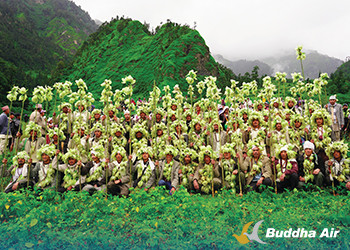
According to Hindu scriptures, Goddess Parvati, the consort of Lord Mahadev, manifests in many forms. Surma Devi is one of them. A lake named Surma Sarovar (4,350 meters) is situated on the border of Darchula and Bajhang and bears her name. There is also a Surma Bhawani temple in Ghajir, Ward No. 3 of Api Himal Rural Municipality.
Surma Bhawani is worshipped as a goddess who fulfills devotees’ wishes. Every year, the Surma Bhawani Jatra is celebrated in Maldesh. According to cultural expert Biruwa Manyal of Ghajir village, the Surma Jatra is observed three times a year: for one day on Chaitra Ashtami, for fifteen days in Saun, and for two days during the Navaratri of Bada Dashain.
Once every alternate year, a grand jatra is held. On that occasion, there is a tradition of undertaking a pilgrimage to Surma Sarovar. According to Manyal, the jatra that begins on the auspicious new moon day of the Nepali month of Shrawan concludes on Janai Purnima.
Devotees heading for Surma Sarovar must observe a fast from the new moon day onward. They bathe every morning and eat only one meal of pure food a day. Wearing shoes or slippers is forbidden; even while walking to the lake, one must go barefoot.
The jatra begins at the Surma Bhawani temple. Accompanied by traditional music, the procession proceeds to Kshetti village. The next day, hundreds of pilgrims and ‘Bires’ set out toward Surma Sarovar. In this region, it is customary for young men to become ‘Bires.’ Those doing so for the first time are called Balo Bire, while those with experience are known as Budo Bire (Old Bire).
The Surma Bhawani Jatra is the greatest festival of the Maldeshi people. It is believed that worshipping Surma Bhawani fulfills one’s wishes. During the jatra, everyone who arrives in the village is provided with free food and lodging. However, wearing shoes or slippers in the village is strictly prohibited at that time.
Biruwa Manyal
Culture Expert
On the day the pilgrims depart from Kshetti, they halt at Bire Odar. The following day, they reach the lake. Each Bire carries a Bire Lauro (ritual staff). Before reaching the lake, Balo Bires must crawl part of the way, as per tradition. Upon reaching the lake, they bathe, perform rituals, and collect sacred soil from the site.
Right there, the Balo Bires undergo the Bratabandha (sacred thread ceremony) according to Hindu rites. Afterward, they return to Bire Odar and stay there. The next day, they return to Kshetti, where the villagers welcome them with great celebration. On the following day, they reach the Surma Bhawani temple in Ghajir, marking the conclusion of the pilgrimage. T
he Surma Bhawani Jatra, with its profound religious significance, is truly worthy of inscription on UNESCO’s World Heritage list as an intangible cultural heritage.
Sitola Village
Trade has traditionally been the occupation of the Sauka people. Sitola village is an ideal place to study and research their life and culture.
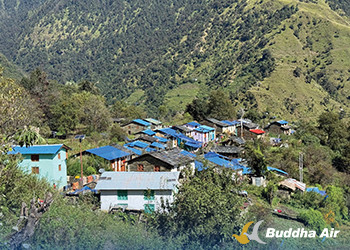
The Sauka community resides in Darchula’s Byas Valley (Changru, Tinkar, and Rapla) and the Marma Valley. At present, the total population of the Sauka community in Nepal is around 3,000. About 300 Sauka people reside in Sitola village, located in Ward No. 6 of Api Himal Rural Municipality. Their ancestors migrated from Bundi, India.
Their traditional occupations are trade and agriculture. Even today, they take Indian goods—utensils, gum, tobacco, and food grains—to Taklakot in Tibet to sell, and bring back carpets, rugs, fancy clothes, jackets, and blankets from Taklakot to sell in Nepal.
Many youths from Sitola village are engaged in trade. Due to migration, most Sauka people now live in Khalanga, the district headquarters of Darchula. Those who remain in the village are engaged in farming and sheep herding. Potatoes, rajma beans, maize, millet, barley, buckwheat, vegetables, and other crops are grown in the village.
Migration has become a major problem. We need a road. If we could bring motorable access to the village, an environment would be created for young people to stay back. Unemployed youths would engage in agriculture.
Bishan Singh Budhathoki Life Member,
Byas Sauka Society
Contact: 984469420
The Sauka community has a distinct identity, with its own language, dress, and culture. Their main festival is Gawala Parva, which they celebrate as the first day of the New Year. This festival falls in Magh–Falgun. In the past, it was celebrated for fifteen days; nowadays, it is observed for three days. Wearing new clothes and enjoying good food are central to the festivities, and Deusi–Bhailo is also played.
Sitola village is well-suited for studying the social life of the Sauka community. However, it lies outside the Api trekking route. One must walk for about 5 hours from Okhal, along the road, to reach Sitola. Plans are to construct a trekking trail from Sitola to Api Base Camp.
Tea House Trekking
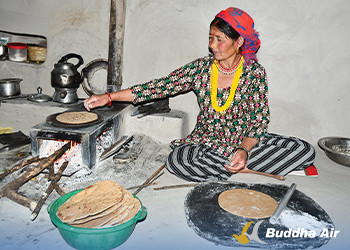
The Api trekking route features homestays and hotel facilities. Local produce is served along the way Tea house trekking to the Api Base Camp is now possible. Along the trail, villages offer basic homestay and hotel facilities. There are hotels at Khaykot, Chhirchhire, Simar, Dhauli Odar, and the Base Camp. Likewise, homestays are available in the villages of Naupata, Thumti, Patha, Kshetti, Khatti, Gunsa, and Siti.
Facilities for food and lodging are available everywhere. I see Nepali trekkers rushing too much. Some even walk until nine at night. Trekking should not be done in such haste. Please come with enough time. Walk slowly. Immerse yourself in the natural beauty here.
Lalmati Dhami Operator,
Bhawana Hotel,Makarigad
Contact: 9865565919
Homestays and hotels emphasize locally produced food. Flatbreads made from buckwheat, millet, maize, and Marsi are available. In addition, dal-bhat with vegetables, porridge made from rice flour, and rice dishes prepared from chino and kaguno are served. Milk, ghee, and buttermilk are also available.
Local alcoholic beverages made from barley and rice are also served. Besides these, instant noodles, beer, and commercially produced liquor are also available.
Homestays and hotels appear to need upgrading in keeping with the times. Camping sites have also been set up at various locations.
Travel Itinerary
- Day One: Kathmandu– Dhangadhi, 1 hour 10 minutes by flight Dhangadhi–Makarigad (1,460 meters), 295 km, 10 hours by jeep
- Day Two: Makrigad–Ghusa (2,200 meters), 6 hours of trekking
- Day Three: Ghusa– Chhirchhire (2,500 meters), 6 hours of trekking
- Day Four: Chhirchhire–Dhauli Odar (3,450 meters), 5 hours of trekking
- Day Five: Dhauli Odar–Api Base Camp (3,900 meters), 2 hours of trekking Full day exploration of the Base Camp
- Day Six: Api Base Camp– Khaykot (2,050 meters), 7 hours of trekking
- Day Seven: Khaykot–Thumti– Naupata (2,280 meters), 8 hours of trekking
- Day Eight: Naupata– Makarigad, 2 hours of trekking Makrigad–Dhangadhi, 10 hours by jeep
- Day Nine: Dhangadhi– Kathmandu, 1 hour 10 minutes by flight
Note: On the return journey, instead of going to Naupata, one can descend directly from Khaykot to Makarigad through Siti.
Contact: Tourism Information Center, Makarigad
Akkal Thagunna – 9849217190
The Storyteller
Mansingh Dhami runs the Jogetal Hotel at Api Base Camp.
Mansingh Dhami of Ghusa village is 43 years old. He is a former chairperson of Ward No. 2 of Api Himal Rural Municipality. It has been three years since he started operating Jogetal Hotel at Api Base Camp. Even before that, from 2011 onwards, he used to run a temporary hotel by pitching a tent from Baisakh to Asar. He sold jerry sweets, vegetables, chowmein, and momos. Those collecting yarsagumba were his main customers.
Nowadays, his hotel provides food and accommodation for tourists. However, the hotel remains closed during Mangsir, Poush, and Magh.
But this alone does not define him. He is also a skilled storyteller. He narrates stories of Api’s natural heritage, history, and culture in an engaging manner. Trekkers can learn a great deal by conversing with him.
One incident stands out. On the night of March 1, 2025, it snowed continuously. He was alone at the Base Camp. The next morning, slipping and sliding with the support of stick, it took him nine hours to reach Dhauli Odar. On a normal day without snow, he would have covered the same distance in just half an hour.
Contact: 9766979510
Joy of a Shepherd
Seventeen-year-old Bishal Singh Bohora is a shepherd to 101 sheep and goats.
Bishal Singh Bohora had been studying in Grade 5 at a private school in Khalanga, the district headquarters of Darchula. Due to COVID-19, his education was disrupted. His parents brought him to Kshetti village and enrolled him in Grade 7 at a community school. But his heart was not in his studies. From a young age, he had a deep interest in sheep and goats.
Seeing his passion, his father bought him 22 sheep. He became a shepherd. Over the past three years, the number of sheep and goats has grown to 101.
After breakfast, 17-year-old Bishal takes the flock to the forest for grazing at 10 a.m. He returns home with them around 5 p.m.
“No matter how much you study, the government doesn’t give you a job,” he says. “Either you have to go to Qatar or return to the village and become a shepherd. That’s why I decided early on to be a shepherd.”
Life as a shepherd is not easy. Yet he finds fulfillment in it. During the monsoon, he has to stay for months in the high pastures with his sheep and goats.
Love in Bloom
The hardworking couple, Ramsingh and Beena, have been running a homestay in Kshetti village.
Nestled in the lap of the Kapil Himal, Kshetti village lies. Only 17 households are permanently inhabited here. Among them is a model homestay run by Ramsingh Bohora and Beena Tamang. They started the homestay eight years ago. At a time, the place can accommodate up to 20 guests.
They have two children—a daughter, Kalawati, and a son, Suresh. Beena’s maternal home is in Naichal village of Bhaktapur. Three decades ago, she ran a carpet factory in Bagdol, Lalitpur. Ramsingh worked as a helper in the same house where her factory was located. That is how they met. Love blossomed, and that turned into marriage.
A year after their marriage, their daughter was born, and they returned to Darchula. From Khalanga, the district headquarters of Darchula, it took four days to reach Kshetti. In the early days, Beena felt overwhelmed. But love bound her to the place. Within a few years, she adjusted to village life. Today, her manners, language, and accent clearly reflect her Sudurpashchim identity.
“I actually find Kshetti village delightful,” she says. “When I go to Kathmandu, I can’t stand the noise and chaos.”
Contact: Ramsingh – 9742401299


