




The forest is nature. A journey into the forest brings calm. Immersed in the music of nature, one can become meditative. Beyond that, wildlife photography demands determination, patience, labour, and courage. Carrying a camera into forests, wetlands, hills, mountains, and rural settlements creates a surge of anticipation. It is not only about observing animals and birds, but also about capturing their behaviour and habits in the frame.
Through study and photography, conservation messages are conveyed. Contributing to conservation in this way brings deep personal satisfaction.
I have travelled not only around Kathmandu, Chitwan, and Bardiya for photography, but also from Mechi to Jumla. I have reached Mardi, Langtang, Ama Yangri, Magin Goth, Ilam, and many other places. I now intend to photograph in Sagarmatha, Tilicho, the Rolwaling region, Ruby Valley, Ganesh Himal, and the Far West.
Photography itself is a creative pursuit. Moreover, wildlife photography is not easy. One must invest substantially in a camera and equipment. One must also allocate time for travel. It requires walking with confidence along cliffs, through silent forests, and across rivers and streams.
The animals one seeks do not appear instantly. Often, long waits are necessary. For example, to photograph the red panda, I travelled to various locations continuously for five years. Similarly, to capture a tiger, I have visited Chitwan and Bardiya more than fifty times.
About a year and a half ago, I met with an accident while photographing birds. I fell while taking pictures along the Manohara River and fractured my right leg.
During my journeys, I have observed that certain species are declining. Danphe, red panda, fukras, and chir pheasant are less frequently seen. This makes it necessary for citizens to feel responsible for wildlife conservation, and for the government to emphasize awareness campaigns. Wildlife education should also be incorporated into school curricula from an early level.
Over the years, I have photographed many birds and animals. Below are the stories of ten among them:
1. Baya Weaver
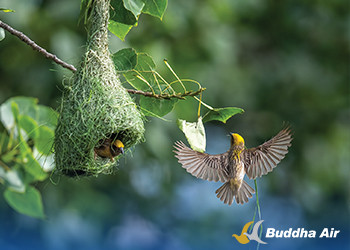
This bird is found in Terai and mid-hill regions, up to an elevation of about 1,500 meters. Its nest-building skill is remarkable, which is why it is often called an “engineer bird.” Males compete to construct beautiful nests in order to attract females. The better the nest, the greater the attraction. They build nests from April to July. This photograph was taken in Balkhu, Kathmandu.
2. Royal Bengal Tiger
Photographing a tiger in Nepal is extremely difficult. It inhabits dense forests. I have visited Chitwan and Bardiya many times in pursuit of this image. Hearing a tiger’s roar is exhilarating. The Royal Bengal tiger is a subspecies native to India, Nepal, and Bangladesh. Males weigh between 205 and 227 kilograms, while females average around 141 kilograms. Nepal currently has a population of 355 tigers. This photograph was taken in Bardiya.
3. Danphe (Himalayan Monal)
Danphe is Nepal’s national bird. It is found between 3,000 and 4,750 meters in elevation, descending to around 2,500 meters in winter. It is shy and cautious by nature. Its primary diet consists of insects. This photograph was taken near Mardi Himal Base Camp.
4. House Sparrow
In Nepal, the house sparrow is found between 72 and 2,200 meters in elevation. It typically nests in cavities and holes in houses and in dense trees. The male is responsible for nest building. During spring, they sing actively. This photograph was taken at my own home in Dhobighat, Patan.
5. Leopard
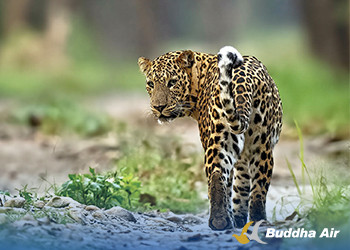
The leopard is a carnivorous animal found from the Terai up to elevations of 4,600 meters. It is also seen in the Kathmandu Valley. It can carry prey weighing twice its own body weight. By nature, it is shy and avoids human presence. It is highly skilled at climbing trees. It often drags its prey up into a tree to feast on it. This photograph was taken in Bardiya.
6. Spiny Babbler
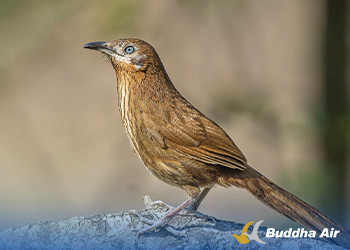
The Spiny Babbler is a bird found only in Nepal. It is shy in temperament. In the morning sun, it emerges onto open slopes and shrubs to sing. It feeds on insects and small invertebrates. I captured this photograph in Kakani, Nuwakot.
7. Jungle Cat
In the past, jungle cats would come from the forest to prey on chickens. Now they rarely appear, and their numbers are declining. This photograph was taken at Gurje Bhanjyang in Shivapuri–Nagarjun National Park.
8. Red Panda
The red panda, found in the Himalayan and mid-hill regions, is shy by nature. A member of the cat family, it is sometimes referred to as the “shining cat.” It feeds on bamboo leaves and tender shoots. Its body length is about one meter, with a tail measuring up to 60 centimeters. The red panda spends most of its time in trees and can move swiftly. Its average lifespan is 8 to 10 years. This photograph was taken at Magin Goth along the Gosainkunda trekking route.
9. Smooth-coated Otter
The otter is found from the Terai to the hills. It inhabits riverbanks and ponds. It is a carnivorous mammal that primarily hunts fish. This photograph was taken at a pond in Bardiya National Park.
10. Sirkeer Malkoha
Two types of malkoha are found in Nepal: the Sirkeer Malkoha and the Green-billed Malkoha. This bird is found from the Terai up to 1,500 meters in elevation. Its length ranges between 42 and 44 centimeters. It feeds on insects, berries, and seeds. Its breeding season extends from March to August. This photograph was taken in Bardiya National Park.
About the Photographer
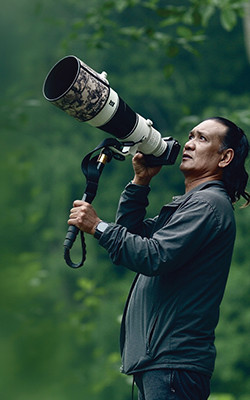
Dasrath Beejukchhen is primarily a wildlife photographer. He has been engaged in photography for three decades. In addition to photography, he works in camera sales and repair. He runs a shop named GND Technology in New Road, Kathmandu.
Born and raised in Biratnagar, Beejukchhen began his career as a freelance photographer, capturing weddings and other auspicious events. Since the COVID-19 pandemic, he has devoted himself fully to wildlife photography.
During lockdown, remaining indoors felt stifling. He began venturing around the Kathmandu Valley with his camera, observing wildlife and capturing them through his lens. Gradually, he immersed himself deeply in wildlife photography.
“I have pursued photography purely out of passion,” says the 54-year-old. “I have not earned by selling my photographs.”
He plans to organize a solo exhibition of his photographs and aims to travel across Nepal to continue his work.
“There may be no such thing as a retired life for me,” he says of his future plans. “As long as I can walk, I will keep taking photographs and remain dedicated to conservation.”
Contact: 9847492146


