



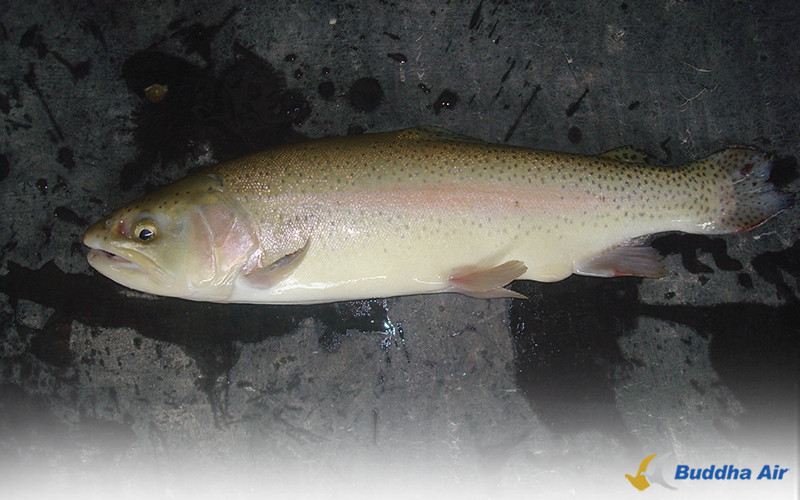
They are called "Rainbow Trout" because their scales appear iridescent, like a rainbow. However, not all trout everywhere are rainbow-coloured. Those raised in water flowing down from the Himalayan glaciers usually show that iridescent sheen. Trout raised in river water tend to look darker.
Trout is a native fish of America. From the United States, it spread worldwide. Since trout was brought to Nepal from Japan, it is often called "Japanese Rainbow Trout." This fish grows well in cold places. It thrives in flowing water with temperatures between 9 and 18 degrees Celsius. Once the temperature reaches 22 degrees, the fish cannot survive.
In terms of taste, trout weighing around 200 grams are considered ideal. It takes about 14 months for trout to reach this size. If raised for a longer time, they can grow as large as 6 kilograms.
Trout became popular because it has no sharp bones and has a rich flavour. It is also high in protein and Omega-3 fatty acids. Protein helps with body growth, while Omega-3 supports blood circulation and brain development.
Rainbow trout is available in restaurants in Nepal's urban areas and in star hotels. Additionally, restaurants have opened in all places where trout farming is practiced. Customers can even catch their own fish with a net from ponds located beside the restaurants.
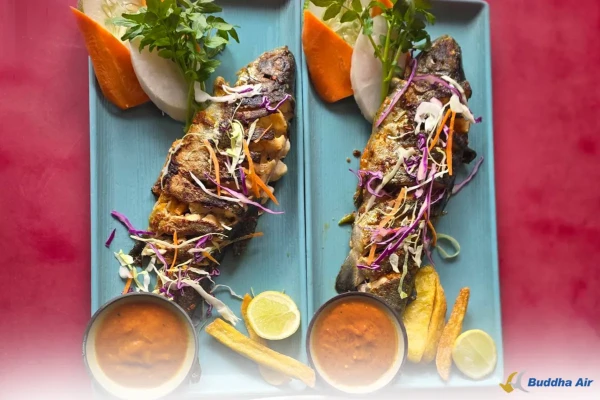
Restaurants cook trout in various styles—especially fried, grilled, with gravy, steamed, chhoila, dried-and-mixed sukuti, momo, soup, and others.
Nepal produces about 1200 tons of trout annually. The leading trout-producing districts include Kaski, Rasuwa, Nuwakot, Parbat, Baglung, Sindhupalchok, Taplejung, Kavrepalanchok, and Jumla.
The Asala fish found in Nepal’s rivers and streams is known as “Snow Trout.” However, snow trout and rainbow trout have no genetic relationship.
Nepal shows great potential for trout tourism. Some places have become well-known solely because of trout.
"Trout farming works best in water that flows from glacial lakes. If we can do that, tourists may come to Nepal specifically for fishing and angling," says fisheries scientist Dr Tek Bahadur Gurung. "Nepal can benefit by linking trout with recreational fishing tourism."
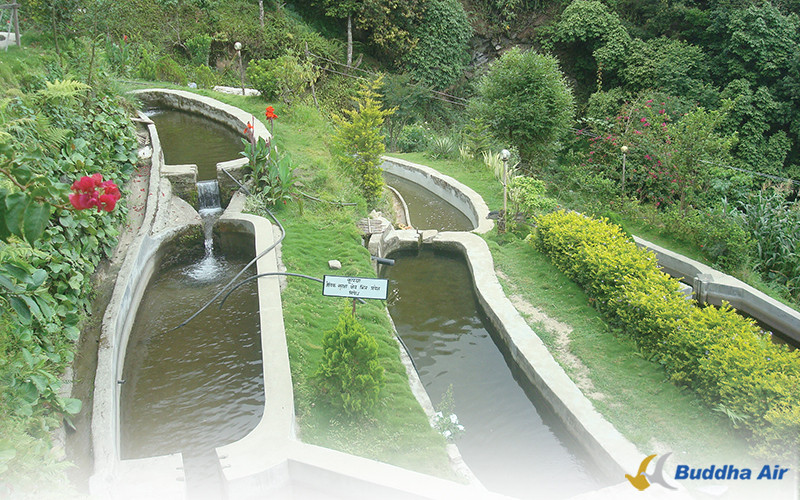
By raising rainbow trout in artificial streams and ponds, one can run a recreational fishing business.
Popular Trout Fish Restaurants
Yamdi Rainbow Trout
Yamdi Bridge, Pokhara
Phone: 9860979321
Rumbaj Himalayan Rainbow Trout Corner
Rasuwa Gadhi, Ghattekhola
Phone: 9840546969
Fall & Trout Village Hotel
Dhovan, Nuwakot
Phone: 9849561982
Sirupate Trout Farm
Badikhel, Lalitpur
Phone: 9849195339
Yangrima Eco Lodge
Helambu, Sindhupalchok
Phone: 9851239857
A Model Restaurant in Pokhara
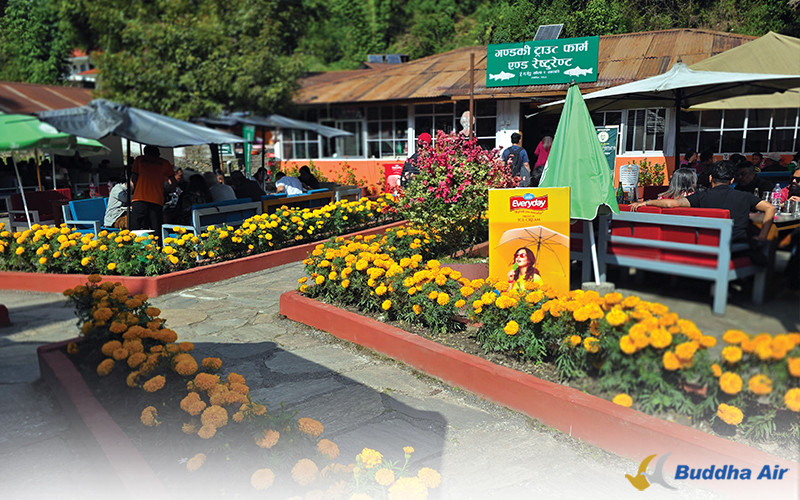
Pokhara’s Gandaki Rainbow Trout Farm consumes 45 tons of fish annually.
Across the country, many restaurants operate alongside trout farms. One exemplary model is the Gandaki Rainbow Trout Farm and Restaurant. Located 20 kilometers from Pokhara's Mahendrapul, this farm consumes 45 tons of fish annually. Of this, 30 tons come from their own farm, while the rest come from nearby farmers.
Situated on 80 ropanis of land in Bhurjungkhola, Ward No. 2 of Machhapuchhre Rural Municipality in Kaski district, the farm offers a family-friendly dining environment. It has facilities such as a swimming pool, a children's park, and a playground. Because of these amenities, both locals and tourists visiting Pokhara come here to taste trout.
Visitors can catch their own fish with a net from the ponds where trout swim freely. Fishing facilities are also available. For accommodation, the cottages here can house up to 30 guests at a time. The restaurant's capacity is 300 people.
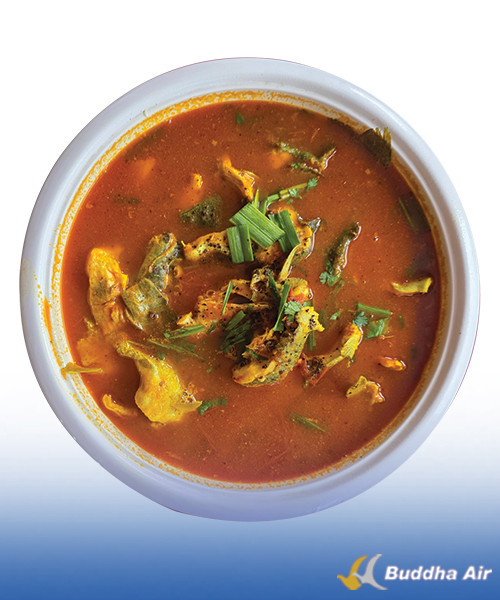
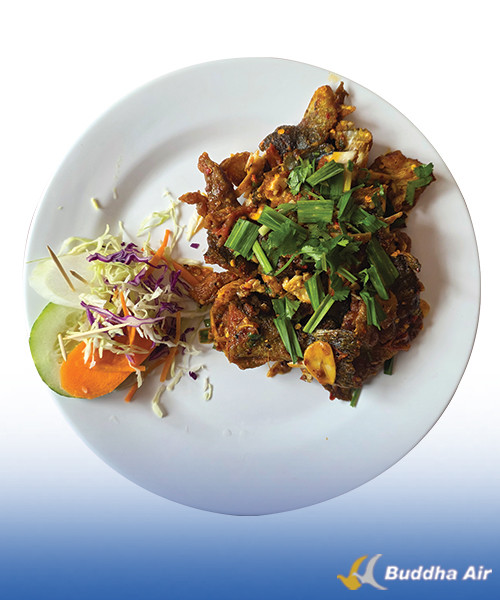
A dozen varieties of trout dishes are available—fried, grilled, with gravy, steamed, chhoila, sukuti mix, traditional-style soup, sekuwa, boneless preparations, momos, and more. Eating soup with the local rice variety Jetho Budho is a common tradition. Other dishes are enjoyed as snacks and appetizers.
This farm was established by locals Lachhin Gurung and Amrit Gurung, inspired by fisheries expert Dr Tek Bahadur Gurung. Lachhin, who returned from the UK, and Amrit, who returned from Japan, have become exemplary entrepreneurs. “We are Nepal’s largest restaurant in terms of trout fish cooked,” Lachhin says. “Our business is growing every day.”
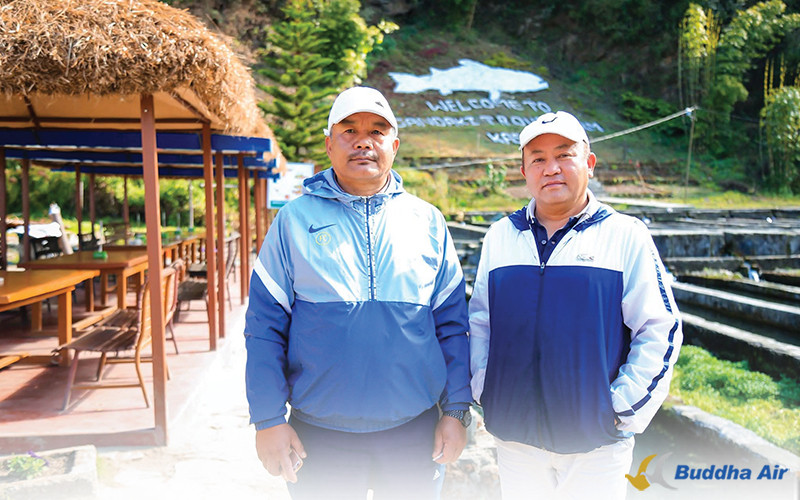
The farm employs 35 people. They began trout farming in 2010 with 3,500 fry. Today, they raise 200,000 fish annually.
Contact : Gandaki Rainbow Trout Farm & Restaurant
Bhurjungkhola, Kaski
Phone: 9851039338, 9856029579
Trout Highway
The Pasang Lhamu Highway connects Kathmandu to Rasuwa via Nuwakot. From Balaju Bypass in Kathmandu onward, restaurants selling trout begin appearing near Jitpurfedi, lining the highway. That is why people commonly call it the “Trout Highway.”
In the ponds beside these restaurants, fish are caught right in front of customers with nets. The fish are weighed and cooked on the spot. Some restaurants even offer lodging facilities.
The history of trout restaurants is not very long. In Dhovan, Nuwakot, Gopal and Kanchimaya Lama opened a restaurant in 2000 AD (2057 B.S.). They were the first farmers in Nepal to raise trout. After successfully growing 400 trout fingerlings provided by the Fisheries Research Center in Trishuli in 2056 B.S., they opened their restaurant.
Bravo, Dr Tek Bahadur!
The fisheries scientist who introduced trout to Nepal is Dr Tek Bahadur Gurung. In 1988, the Government of Japan gifted him trout fish. There is an interesting story behind this. In October 1987, he got the opportunity to travel to Japan for fisheries training. At that time, he was working at the Fisheries Research Center in Pokhara.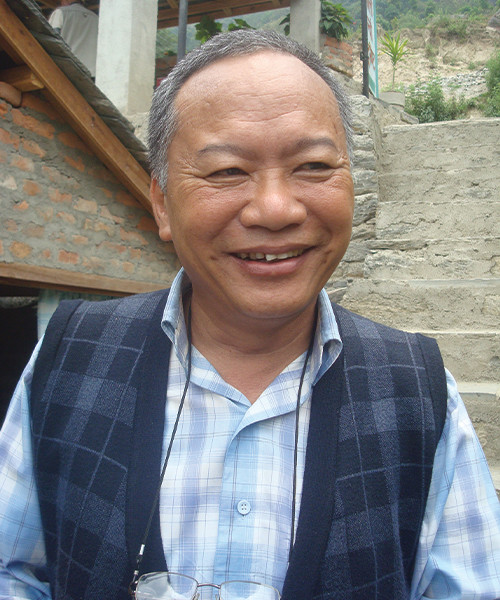
He trained for nine months in Kobayashi City of Miyazaki Prefecture. During the closing ceremony, his presentation impressed the governor. "Mr Tek Bahadur, what gift shall I give you?" the governor asked.
Back then, it was common for Nepalis returning from Japan to bring watches, tape recorders, video decks, radios, and other electronics. "I said, 'We Nepalis suffer from protein deficiency. If I could take trout fish to Nepal, perhaps it could help address that! Nepal has climate and water conditions similar to Japan so that trout could thrive there," Dr Gurung recalls. The governor agreed.
After returning to Nepal, Dr Gurung completed all the necessary paperwork. Through the Department of Agriculture, he sent an official letter to Japan. Four months later, Japan sent 50,000 fertilized eggs to Nepal. From Pokhara, he was assigned to duty at the Fisheries Research Centre in Godavari. Ninety-nine percent of the eggs were hatched successfully.
The fry hatched, but there was a problem—there was no feed for raising them. As a result, only a few fish survived. The team dedicated itself to developing fish feed. Later, Dr Gurung was transferred to Godavari. One hundred mature brood fish were then sent to Trishuli, where Japanese volunteers also provided support.
Only after producing their own feed and constructing hatcheries did they allow the private sector to start trout farming from 1995 onwards. Gurung considers the contributions of his colleagues—Sadhuram Basnet, Purushottam Lal Joshi, Bhola Pradhan, and Ash Kumar Rai—to be truly invaluable to the development of trout in Nepal.
Several years before Dr Gurung, trout were brought to Nepal at the wish of King Mahendra. But due to a lack of knowledge and technology, those fish did not survive. All the trout spread across Nepal today are descendants of the fish Dr Gurung brought as a gift.
Having served as Executive Director at the Nepal Agricultural Research Council (NARC), Dr Gurung has become a source of inspiration for fish farmers.
What if, at that time, he had asked the Japanese governor for a tape recorder or a watch? Those would have worn out long ago! Because he asked for trout, we can enjoy its taste today.
Thank you, Doctor, for your good deeds!


