




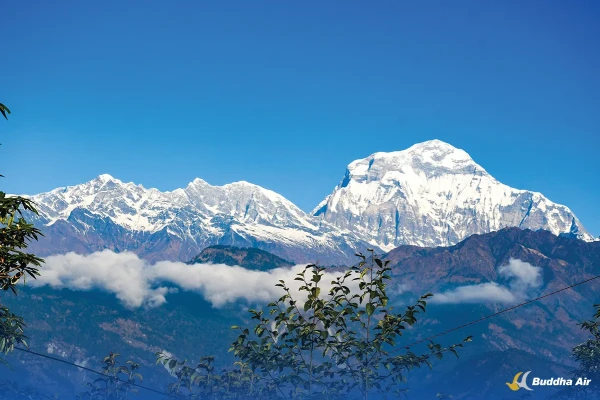
For trekkers who wish to immerse themselves in the confluence of nature, culture, and spirituality in a short period, Karbakeli Eco Trek is an appropriate trek route. It connects the famous hill station of western Nepal, Poon Hill, with Karbakeli thaan (shrine) and Beni Bazaar.
This trekking route has been branded with Karbakeli thaan at Kafaldanda (2,330 meters), located in Ward No. 8 of Annapurna Rural Municipality in Myagdi District, as its focal point.
Every year, thousands of trekkers visit Poon Hill. After climbing the uphill trail from Ulleri and reaching Poon Hill, they usually return via Tadapani towards Ghandruk village. Therefore, whether coming from Ulleri or Ghandruk, a new trekking route has been introduced to attract them from Poon Hill through Phulbari to Karbakeli thaan.
The place where Karbakeli thaan is situated is called Kafaldanda. Under the leadership of retired British Army veteran Cham Bahadur Pun and through community-level efforts, the construction of Karbakeli thaan, Pun Community Museum, community guest houses, and the branding of the Karbakeli Eco Trek have transformed Kafaldanda into a tourist destination.
The contribution made by veteran Cham Bahadur to the social, educational, cultural, and tourism development of his birthplace is exemplary.
From Kafaldanda, a long range of mountains can be seen to the north. Likewise, beautiful villages can be seen to the west and south. During the trek, one can walk while gazing at mountains such as Gurja, Churen, Dhaulagiri, Nilgiri, Machhapuchhre, and Annapurna.
There is a dense rhododendron forest from Ghodepani to Phulbari. The calm, cool environment, with its chirping birds, enchants visitors.
Karbakeli area is suitable for studying the traditions, culture, and lifestyle of the Pun community. Villagers warmly welcome and host guests with open hearts.
The trekking route has hotels and homestays that also offer seasonal Nepali dishes, as well as Chinese, Indian, and continental cuisine.
“We branded Karbakeli Eco Trek to preserve the identity of the Pun community while contributing to poverty alleviation through tourism. Gradually, this trekking route is becoming popular among tourists. We are encouraged.”
l Cham Bahadur Pun
Social Worker
Contact: 9849626129
Karbakeli Eco Trek begins in Ghodepani, Myagdi. After reaching Kafaldanda via Poon Hill and staying overnight at Karbakeli, there are four options for descending to Beni Bazaar. The first option is via Baisari to Beni; the second is via Rima, Aul Gaun, and Baisari to Beni; the third is via Mahabhir and Mallaj to Beni; and the fourth descends from Karbakeli thaan through Nagi and Phalamedanda to Beni.
Trekking in this region is possible year-round. During the monsoon, there is the beauty of greenery and ground mist. In October–November, the mountains appear crystal clear. In January–February, the area is blanketed in white snow. Likewise, in April–May, red rhododendrons bloom, turning the forests along the trail crimson.
The trek can be completed in four days from Pokhara. The journey may begin either from Ghodepani or Beni. Trekking from Ghodepani involves more downhill walking, whereas starting from Beni means mostly uphill climbs.
This trekking route is suitable for trekkers of all age groups, from children to older people.
Poon Hills
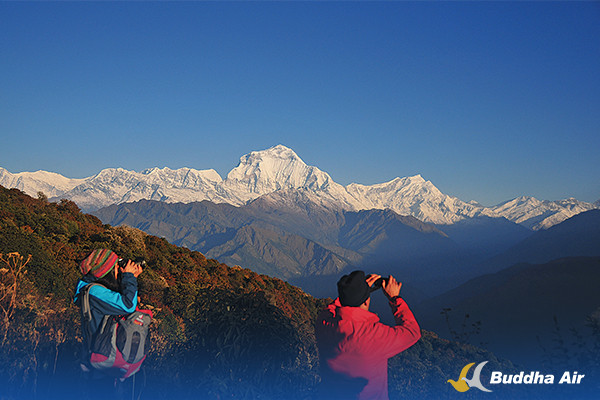
Major Tek Bahadur Pun deserves the credit for planting the seed of tourism in Poon Hill. Born and raised in Khibang village, nestled in the lap of Poon Hill, he gave the name “Poon Hill” to what was once called Lungtung Hill.
Poon Hill (3,210 meters) is a renowned hill station. It is a destination for viewing mountain ranges, as well as sunrise and sunset. From here, a long chain of mountains, including Dhaulagiri, Annapurna, and Machhapuchhre, can be seen. At sunrise, the golden rays of the sun kiss the mountains.
There is a tea shop and a view tower on the hill. Other than that, there are no physical structures. There are no hotel facilities either. However, tea and coffee are available on the hill in the early morning. For overnight stays, hotels are available at Ghodepani, the base camp of Poon Hill.
Ghodepani (2,874 meters) has 43 households. Beautiful houses roofed with colourful corrugated sheets. There are 26 hotels here—clean hotels with hot and cold water facilities, where everything from dal bhat to pizza is available.
Tourists begin climbing uphill from Ghodepani early in the morning, and it takes about an hour to reach Poon Hill. After viewing the Himalayas from the hill, some return via Ulleri while others go through Ghandruk. In today’s context, as the Karbakeli trekking route has already been explored, some tourists also descend to Beni Bazaar from the hill via Phulbari and Karbakeli thaan.
A motor road connects Naya Pul in Kaski via Birethanti to Ghodepani. Likewise, there is a road connection from Pokhare Bagar in Myagdi to Ghodepani. We want the government to black top both roads leading to our village.
Mina Pun
Hotel Operator, Ghodepani
Contact: 9866008785
The credit for planting the seed of tourism in Poon Hill goes to Tek Bahadur Pun, a retired Major of the Indian Army. A resident of Khibang village in Myagdi, he is the pioneer of tourism in Poon Hill. It was he who named Lungtung Hill as “Poon Hill.” In those days, he encouraged tourists to climb up from Ghodepani to the hill by putting up a wooden signboard reading “Way to Poon Hill.” He also educated villagers about tourism. He continuously inspired the community to preserve the traditions and culture of the Pun community.
A view tower has been built at Poon Hill in his honour.
Phulbari
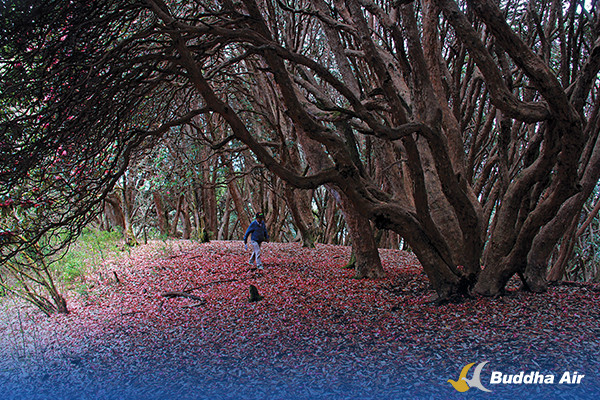
Phulbari is the southwestern base camp of Poon Hill. Tourist accommodation facilities are available here as well.
Since it is a natural garden where colourful flowers bloom, a pastureland in Myagdi was named Phulbari (“flower garden”). From Phulbari (2,925 meters), one can see a line of mountains including Hiunchuli, Annapurna South, Annapurna I, Baraha Himal, Nilgiri South, Dhampus Peak, Tukuche Peak (Manapathi), Dhaulagiri, and Gurja Himal.
Phulbari is the base camp of Poon Hill. Poon Hill can be reached after an hour’s uphill climb from Phulbari, which lies to the southwest of Poon Hill.
The Phulbari area has dense rhododendron forests. A wide variety of rhododendrons bloom in this region, along with different kinds of other flowers. One can hear the chirping of birds such as the Himalayan monal and pheasants. One may even unexpectedly encounter wild animals in the forest.
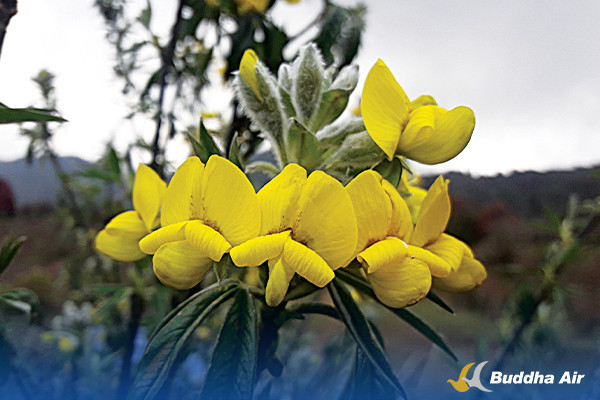
Starting from Phulbari, one can trek to many places, such as Karbakeli, Nagi, Khopra, Moharedanda, and Shikha.
Five families live in Phulbari. In earlier times, villagers from lower villages such as Rima, Ramche, and Kafaldanda kept cows and buffaloes in the local pastures from April to September. Nowadays, the practice of maintaining cattle sheds has disappeared.
In Phulbari, tourism entrepreneurs Yam Pun runs Phulbari Guesthouse, Gummaya Pun runs Hotel Annapurna, and Maya Tilija operates Green View Guest House.
From here, Karbakeli thaan can be reached after a four-hour downhill descent.
Lunch at Aahaldanda
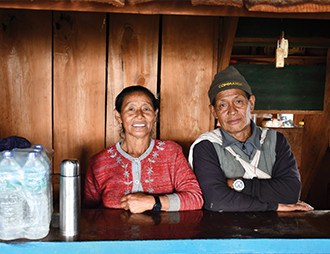
At Aahaldanda, along the trekking route, the family of Bhakta Bahadur Purja runs Hotel Himalayan View and Restaurant. Aahaldanda is a suitable place for lunch while climbing uphill from Karbakeli thaan or descending downhill from Poon Hill.
“We provide meals, snacks, and lodging,” he says. “We also serve seasonal vegetables and fruits available in the villages.”
It has been three years since the hotel started. It has 10 rooms. In his youth, Bhakta Bahadur spent ten years working in Gulf countries. Even at 65 today, he continues to live an equally active life.
Contact: 9867972260
Karbakeli Baba
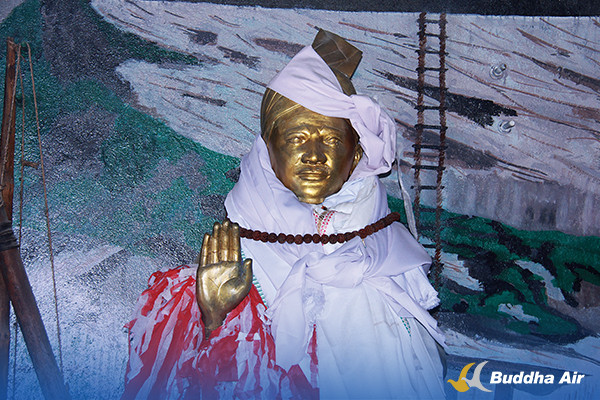
Karbakeli Baba had attained divine power, tantric knowledge, and ashta siddhi (eight supernatural attainments).
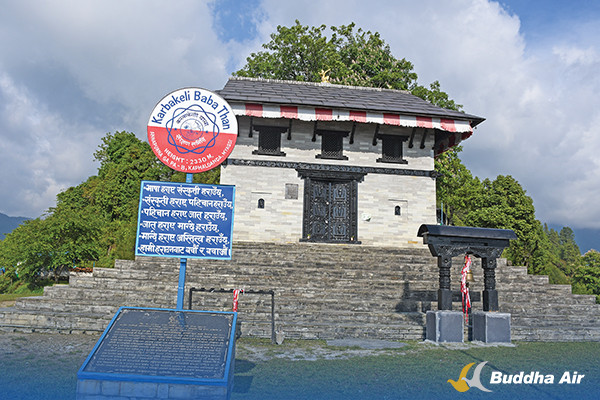
The Pun community has its own distinct art, traditions, and culture. “Karbakeli Baba” is their ancestral deity. In his honour, Karbakeli thaan has been built at Kafaldanda.
Karbakeli thaan resembles a traditional village house. Inside it are statues of Karbakeli Baba, his two wives,, Himala and Phimala, and his sons, Ramchan and Kulchan.
Karbakeli had attained divine power, practised tantric techniques, and achieved the eight siddhis. The identity of the Pun community is reflected in his life story.
He lived in the naturally beautiful Kafaldanda. From here, delightful views of the Himalayas, sunrise, and sunset can be seen.
Karbakeli Baba had developed systems of healing and protection to form human communities and develop agriculture. His elder wife, Himala, was also a woman of extraordinary powers. She cared for cattle and livestock. Therefore, when their cattle or children suffered from illness or hardship, she identified medicinal herbs and roots for remedies and carried out treatments.
Karbakeli’s younger wife, Phimala, also developed methods for making clothes from forest plants, sheep wool, and goat hair.
Daily worship rituals are performed at Karbakeli thaan. A special fair is held twice a year: on the full moon of Nepali month Jestha or the first bright Tuesday of the month, and on the first Tuesday of Mangsir.
Sacrifices offerings are not made to Karbakeli Baba. However, sacrifices are offered to his two sons, Ramchan and Kulchan. During the fair, nausinge (roosters) and duisinge (rams) are sacrificed.
A community guesthouse has also been built here, accommodating up to 60 people overnight. Its income is spent on developing the Karbakeli area.
Karbakeli trek offers an exciting experience. If one wishes to come directly to Karbakeli thaan without trekking, there is also a motor road. The distance from Beni Bazaar to Kafaldanda is 47 kilometres, and the journey takes about 3 hours by jeep. Please inform us in advance before coming!
Rabi Garbuja Pun
Tourism Activist
Contact: 9846827493
Pun Community Museum
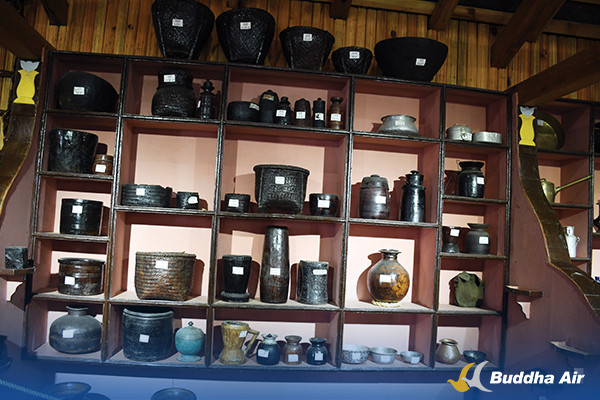
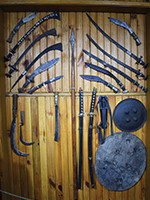
An attractive two-story museum building displays objects that reflect the lifestyle of the Pun community.
An artistic museum has been built within the premises of Karbakeli Thaan. Karbakeli Baba Conservation Committee established the Pun Community Museum to reflect the art, culture, and lifestyle of the Pun community.
In the two-storied building, constructed in a traditional style using stone and wood, materials reflecting the Pun community’s life-cycle rituals from birth to death have been displayed. Statues of Karbakeli Baba and his wives, Himala and Phimala, have also been placed here.
Archaeological objects are displayed on the museum's upper floor. Likewise, on the ground floor, items made of wood, stone, and nigalo, including the janto (grinding stone), dhiki (traditional rice husker), and kol (oil press), have been kept.
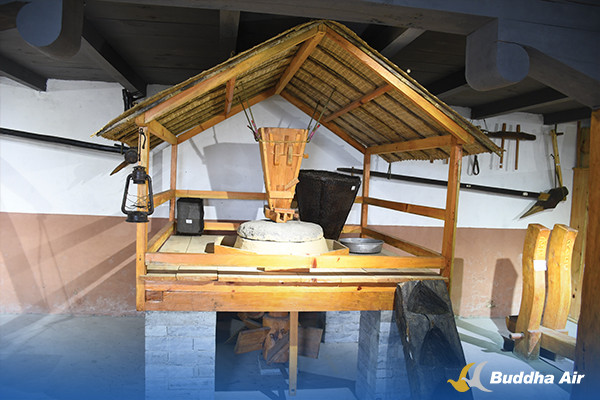
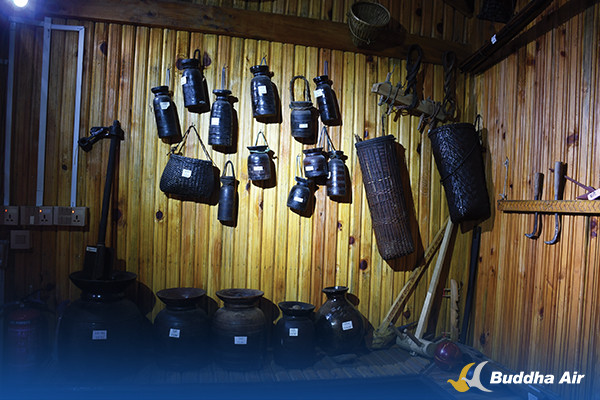
Visitors are allowed to touch the items on the ground floor. There is also a library room where one can sit and study the identity of the Pun people, as well as the history, culture, and lifestyle of Nepal’s ethnic communities.
The museum also displays photographs of record-holding athletes, social workers, and leaders from the Pun community, along with their brief introductions. It is a way to honour the talents that have contributed to society and the nation.
Some of the items displayed here were collected from villages. Benefactors donated some, while others were purchased. To reflect Pun culture, some objects, such as dhiki, kol, and janto, were newly made and placed in the museum.
This has become a model museum for the entire Gandaki Province. The Pun Society UK and local villagers made significant contributions to the construction of the museum.\
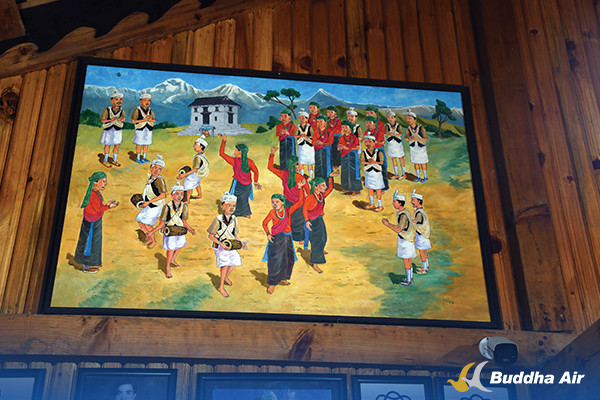
Diya Pun, the first actress from the Pun community and a climber of Mount Everest, inaugurated the museum on 29th November, 2022.
Purkhyauli
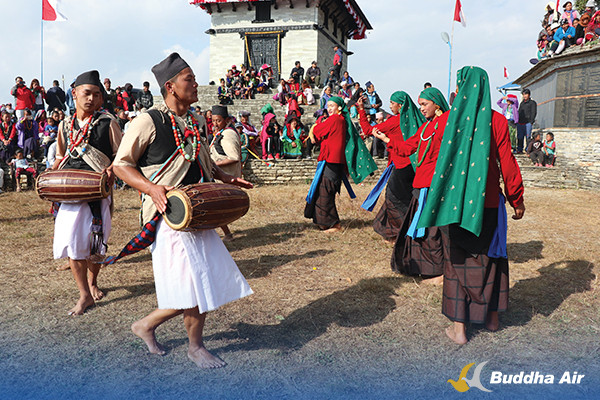
In the Purkhyauli dance, male performers dance dressed as women. They are called Maruni.
The Karbakeli area has a dense Pun community settlement. They have their own distinct culture. In the Pun community, there is a tradition of performing Purkhyauli (Sorathi) dance. They participate in ‘Purkhyauli’ in times of both sorrow and happiness.
They sing and dance to joyful songs during happy occasions. In times of sorrow, however, they only sing and do not dance. Songs are also sung during Karbakeli worship and Bhume worship. They also perform Purkhyauli at weddings, bratabandha (sacred-thread ceremonies), feasts, and similar occasions. During weddings and bratabandha, singing and dancing continue throughout the night. The lyrics of the songs vary according to the context. During fairs and festivals, ‘Chudka’ songs are sung for entertainment.
Traditionally, men dress as women. The male performer dressed as a woman is called Maruni, while the man who plays madal drum is called ‘Madale’. Instruments such as the madal and jhyali (cymbals) are used in the dance.
During the Karbakeli trek, Purkhyauli dance is performed upon request by tourists. In particular, Purkhyauli can be studied in places such as Kafaldanda, Phalamedanda, Nagi, Mahabhir, and Banskharaka.
Besides this, songs such as Salaijo, Yanimaya, Shirphule, Sedo, and Thadi Bhaka are still alive in village communities and can be observed during the journey.
The Pun community worships nature. Jhankri (shaman) tradition still survives in villages. Both women and men work as jhankris. To heal illnesses, they perform divination and administer traditional treatments.
In our Pun community, Jhankris are highly respected. Jhankris are essential during clan worship, Bhume worship, and Pun Day celebrations. We perform worship while beating the dhyangro drum. When someone in the village is ill or facing hardship, we also perform divination and provide treatment.
Devi Kharoja Pun
Jhankri
Galeshwardham
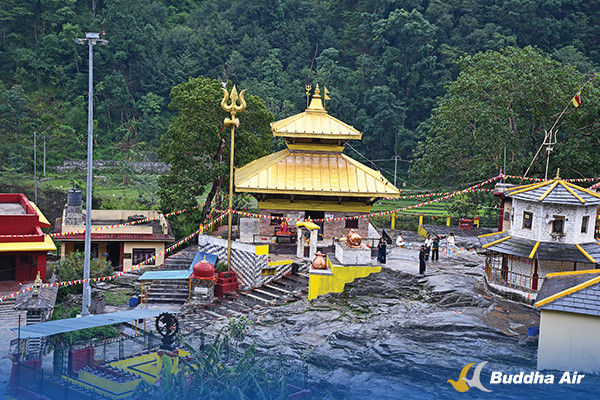
Galeshwar Temple stands on a vast circular rock (chakrashila) measuring 9 ropani at the confluence of the Kali Gandaki and Raghu Ganga rivers.
Galeshwardham lies three kilometers north of Beni Bazaar, the district headquarters of Myagdi. Galeshwar Temple stands on a vast circular rock measuring 9 ropanis at the confluence of the Kali Gandaki and Raghu Ganga rivers. On this sacred rock are heritage sites including a Shiva temple, a self-manifested Jyotirlinga Shaligram, Jalbaraha Kund, 108 Shiva lingams, and caves.
Galeshwar is associated with the myth of ‘Shree Swasthani Brata Katha’. When Sati Devi sacrificed her life by jumping into the burning fire after her husband, Mahadev, was insulted during the sacrificial ritual of her father, Daksha Prajapati, Mahadev carried her body toward the Himalayan mountains. It is believed that her throat fell here, and Shiva then made this place his abode. Therefore, this place came to be known as Galeshwar (“gala” meaning throat). Over time, Galeshwar became famous as a pilgrimage site after a sage settled here, building a small hermitage and temple. That sage was Galeshwar Baba. Fairs are held here on Mondays of the Nepali month Shrawan, during Bala Chaturdashi, and on Maha Shivaratri.
The Jyotirlinga here is believed to have manifested on its own. Another important belief is the story that Emperor Bharata of ancient India attained liberation after meditating here for over three births: in the first, as King Bharata; in the second, as a deer; and in the third, as Jada Bharata.
Beni Municipality itself is a tourism product. Beni Bazaar stretches north and west along the banks of the Kali Gandaki and Myagdi rivers. Located 82 kilometres from Pokhara, Beni Bazaar is also the gateway to Muktinath.
There are many heritage sites within Beni Municipality: Dholthan, the capital of the former Parbat Kingdom; Kotbhandar; Singa Tatopani Hot Spring; Jyamrukkot; Himalayan scenery; Cave Hill; Lovely Hill; Swargashram; and the lifestyles of various ethnic communities. Religious sites include Galeshwardham, Jagannath Temple, Maharanithan, Beni Stupa, Navadurga Temple, Bhartibam Shivalaya, Pulatsyapulashram, and Balamukteshwar.
Beni can be branded as a spiritual city. A beautiful garden of ethnic diversity, Beni is home to communities including Chhetri, Magar, Pun, Chhantyal, Newar, Bahun, Bishwakarma, and Thakali, living together in harmony.
Beni is also a gateway for adventure trekkers. From here, one can travel along the Dhaulagiri Trek, Gurja Trek, Khopra Trek, Karbakeli Trek, and Guerrilla Trek.
Galeshwar is a sacred land for followers of Hinduism. Pilgrims, especially from Nepal and India, come here. Ninety percent of pilgrims travelling to Muktinath do not return without visiting Galeshwardham.
Madhav Prasad Regmi
Chairperson, Galeshwar Shivalaya Area Development Trust
contact : 9857624484
Souvenirs
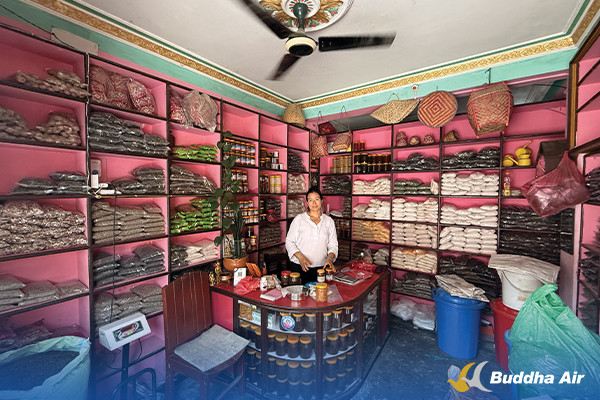
As souvenirs from villages along the trekking route and from Beni Bazaar, visitors can bring back timbur (Sichuan pepper), nettle powder, hemp products, legumes, millet and buckwheat flour, gundruk (fermented leafy greens), honey, radi-pakhi (traditional woollen blanket and shawl), allo cloth, dhaka fabric, bags, and incense sticks.
Welcome to Banskharka
Our village, Banskharka, lies in Ward No. 1 of Jaljala Rural Municipality in Parbat District. Whether climbing uphill to Karbakeli from Beni or descending downhill from Karbakeli, we are always ready to welcome visitors to Banskharka. Three houses in our village offer homestay facilities. We offer a package for NPR 1,100 that includes a non-vegetarian dinner, a bed, and breakfast.
New hotels and improved facilities have recently been introduced for visiting tourists.
We run Dhaulagiri Hotel in Banskharka. A room here costs NPR 1,200. Guests can enjoy a family-like environment. The hotel, established by my maternal uncle Devendra Paija, has been operated by our family.
Ram Garbuja, Hotel Operator,
Contact: 9866034935
The hillsides here are covered with orange orchards. Therefore, Banskharka has earned the identity of an “Orange Village.” From our village, one can view the Dhaulagiri, Gurja, and Nilgiri mountains. So, do not come only for lunch; come to stay for a night as well.
Subash Garbuja
Homestay Operator, Contact: 9846765544
Travel Itinerary
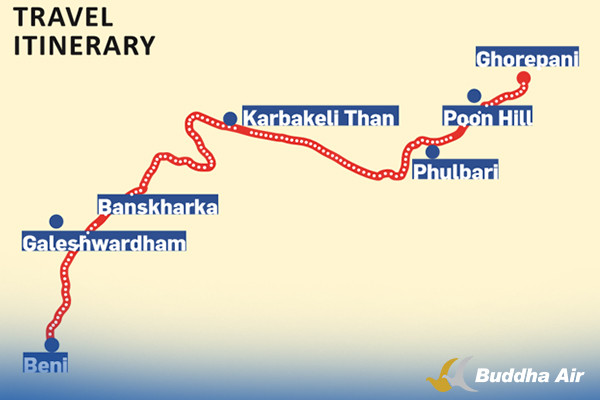
First Day : Kathmandu–Pokhara: 200 kilometres, six hours by vehicle or 25 minutes by air.
Pokhara–Naya Pul–Ghodepani: 61 kilometers, 3.5 hours by jeep.
Second Day: Ghodepani–Poon Hill–Karbakeli Than: 6 hours of trekking.
Third Day : Karbakeli–Banskharak–Beni Bazaar: 6 hours of trekking.
Fourth Day : Beni Bazaar–Pokhara–Kathmandu


