




A cultural city. A city of temples. The capital of art. A treasure house of Newar lifestyle. A city of devotees. Bhaktapur–a living museum.
Located 14 kilometers east of Kathmandu, Bhaktapur Municipality is rich in historical, religious, cultural, and natural heritage.
Bhaktapur city, situated at an elevation of 1,401 meters, covers an area of 6.88 square kilometers. According to the 2021 National Population Census, its population is 81,748. More than 90 percent of the population are Newars.
In 1979, the United Nations Educational, Scientific and Cultural Organisation (UNESCO) designated Bhaktapur’s Fifty-Five-Window Palace, Golden Gate, Nyatapola Temple, and other heritage sites as World Heritage sites.
In the Nepal Bhasa language, Bhaktapur is called “Khwo-pa.” It is an ancient city. According to legend, there was already a settlement here during the Kirat period. At that time, Bhaktapur was known as “Khopringgram.”
The city has stone inscriptions, sculptures, and chaityas dating from the Licchavi period. According to historians, King Ananda Deva (1204–1224 B.S.) is credited with making Bhaktapur his capital and ruling from here. He was a king of Nepalmandala. At that time, Kathmandu Valley was known as “Nepalmandala.”
Bhaktapur remained the capital of Nepalmandala until the reign of King Yaksha Malla. After his death, disputes among his sons led to the division of Nepalmandala into three kingdoms: Bhaktapur, Kantipur, and Lalitpur. His three sons became the kings of these three kingdoms.
The period from the reign of Yaksha Malla to that of Ranjit Malla is considered the “Golden Age” of Bhaktapur. Many important heritage structures were built during this period.
As part of his campaign to unify Nepal, King Prithvi Narayan Shah of Gorkha conquered Bhaktapur in Kartik 1826 B.S., and the city was incorporated into Greater Nepal.
Compared with other places, Bhaktapur Municipality is doing a good job in cleanliness and heritage conservation. However, it should restore old works of art rather than demolishing them and building new ones. It should also encourage residents to build houses in the traditional Newar style. Another important step is to make the entire city of Bhaktapur vehicle-free.
Rabindra Puri
Heritage expert
Bhaktapur has become a major tourist destination and a model city in Nepal for preserving cultural heritage. Under the slogan “Our art and culture, the heritage created by our ancestors,” Bhaktapur Municipality has taken the lead in preserving both tangible and intangible heritage.
The municipality charges entrance fees to foreign visitors who tour the heritage areas. Indian and Chinese citizens are charged Rs. 500, while visitors from other countries are charged Rs. 2,000.
Statistics show that in recent years, more than 220,000 foreign tourists have visited Bhaktapur city each year. A large number of Nepalis also visit the city, but their numbers are not usually recorded.
Foreign visitors are generally taken on hurried tours of Bhaktapur. According to Dipesh Raj Sharma, chairman of the Bhaktapur Tourism Development Committee, travel companies generally sell three-hour tour packages. As a result, visitors do not have enough time to explore the city’s cultural heritage properly.
Travel companies allocate only 3 hours for tours of Bhaktapur. As a result, tourists do not have enough time to understand Bhaktapur properly. At least one full day is needed to explore the city.
Dipesh Raj Sharma
Chairperson, Bhaktapur Tourism Development Committee
Women’s participation in Bhaktapur’s tourism sector is increasing. Women are leading in hotel management and handicrafts. Now, a strong presence of women is also needed in leadership roles in tourism-related organizations.Laxmi Awal
Tourism professional
Visitors should set aside at least one full day to explore Bhaktapur city. There is much to see, understand, study, and experience here. One could easily spend a week staying in the city and exploring its attractions.
There are many heritage sites here worth studying and observing, including monasteries and temples, Buddhist viharas, chaityas, ponds, rest houses, and traditional stone water spouts.
Writer Jagadish Shamsher Rana wrote a book titled Bhaktapur: The Capital of Dance and Music. Indeed, throughout the year, visitors can enjoy traditional dances, music, and musical performances in the city’s courtyards, open performance spaces, temples, house compounds, streets, and lanes.
What if Bhaktapur Municipality organized free cultural performances every evening at a spacious venue, such as Durbar Square, to attract tourists to stay overnight? This would, on the one hand, help local artists earn a living and, on the other, allow tourists to experience the authentic local culture and traditions.
Bhaktapur could be marketed as a place where tourists visiting Nepal should not miss an evening of music and culture. Another possibility is to install attractive lighting at religious heritage sites, which would draw visitors with their beauty at night. Such initiatives would increase tourist activity not only within the city but also in hotels and resorts in the surrounding areas.
Bhaktapur itself is an open university. There is much to see, understand, and enjoy here. This article focuses only on Bhaktapur Durbar Square, Taumadhi Square, Dattatraya Square, and Pottery Square.
Bhaktapur Durbar Square
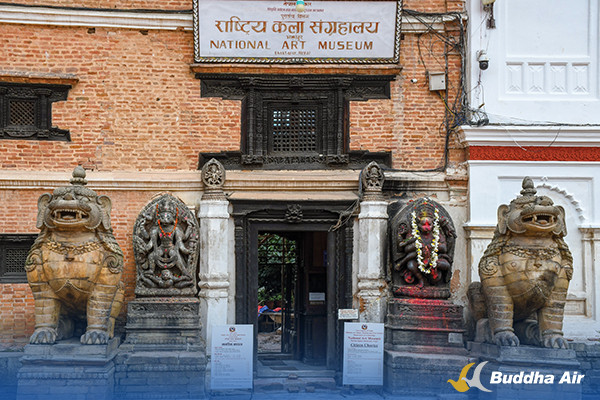
Some of the finest examples of woodcarving, stone carving, and metalwork are found here. Bhaktapur Durbar area is home to many important heritage sites, including Taleju Bhawani Temple, Golden Gate, Golden Spout, Fifty-Five-Window Palace, the four Hindu holy sites known as the Char Dham (Jagannath, Badrinath, Rameshwar, and Kedarnath), Yakeshwar (Pashupatinath), Siddhi Vatsala Temple, the Great Bell, Nritya Vatsala Temple, Singh Dhwakha Palace, the statue of King Bhupatindra Malla, Silu Mahadev, and Chyasi Mandap.
The Fifty-Five-Window Palace here is an impressive work of art. Its third floor has 55 windows. Built during the reign of King Bhupatindra Malla, the palace is richly decorated with intricate woodcarvings. The first floor has carvings depicting 84 musical postures, while the second floor features murals reflecting the cultural lifestyle of the time.
Taleju Bhawani Temple stands in the main courtyard next to the palace. The idol of Taleju Bhawani was brought here from Simraungadh. Taleju was the family deity of the Malla kings. During the Malla period, royal coronations and other auspicious ceremonies were held here.
The main courtyard is filled with beautiful examples of woodcarving, metalwork, and painting.
Golden Gate, the main entrance to the courtyard, is also worth seeing. King Ranjit Malla built it. A huge bell stands in front of the Golden Gate. According to local legend, King Bhupatindra Malla had the bell installed to drive away ghosts, spirits, and demons.
Tourists are amazed and delighted as soon as they set foot in Bhaktapur. Bhaktapur Municipality charges foreign visitors an entrance fee of Rs. 2,000. As soon as they enter the Durbar area, they have to buy another ticket to visit the Art Museum. Foreign visitors have not appreciated this arrangement.
Prabhalaxmi Pradhananga
President, Tourist Guide Association of Nepal
Singh Dhwakha Palace stands in the central part of the Durbar area. On either side of its main entrance are large stone sculptures of lions. Today, the building houses the National Art Museum.
Durbar area also has two stone-built temples in the shikhara style: Nritya Vatsala Temple and Siddhi Vatsala Temple.
Siddhi Vatsala Temple was built during the reign of King Jagat Prakash Malla. Its plinth is decorated with sculptures of women and men, including women holding children, as well as horses, rhinoceroses, humans, camels, and various gods and goddesses. The three-storey Nritya Vatsala Temple, meanwhile, was built during the reign of King Jitamitra Malla.
Taumadhi Square
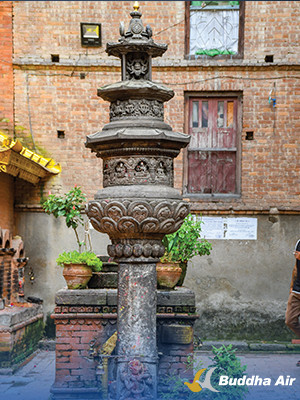 Nyatapola is the tallest temple in Nepal, built in the pagoda style. It stands 108 feet high.
The major attractions of Taumadhi Square include Nyatapola, Bhairava Temple, statues of the Navagraha (the nine planetary deities), Til Madhav Narayan, and the Earthquake God.
Nyatapola is the tallest temple in Nepal and was built in the pagoda style. It is 108 feet high. King Bhupatindra Malla commissioned its construction. Inside the temple, Siddhilakshmi was installed in accordance with Tantric rituals.
Next to Nyatapola stands the three-storey Bhairava Temple. In everyday speech, the deity is also known by names such as Kashi Vishwanath, Akash Bhairava, and Nritya Nath. He is regarded as the protector of the city.
Bhairava temple was originally a one-storey structure. It was later rebuilt as a three-storey temple. There is also a temple dedicated to Gorakhnath nearby.
Bhaktapur Municipality should take greater care to preserve its archaeological heritage. In some places, it has removed old artworks and replaced them with new ones of a similar kind. Old works of art should not be removed in this way. CCTV cameras should also be installed at various locations to improve security.
Diwanchandra Dhaubhadel
Former Chairperson, Bhaktapur Tourism Development Committee
The story of Til Madhav Narayan is interesting. It is said to have been named Til Madhav because the deity emerged from a mound of sesame seeds. Seasame in Nepali corresponds to 'Til' and Madhav is the god. The temple is a two-storey structure with a copper roof. The Earthquake God is also enshrined in the Til Madhav temple courtyard.
Opposite the five-storey temple stands another important temple, the Lakshmi Narasimha Temple. It is the only Narasimha temple in the city of Bhaktapur. Inside the temple is an image of Narasimha embracing Lakshmi. An inscription records that the temple was built during the reign of King Jayasthiti Malla.
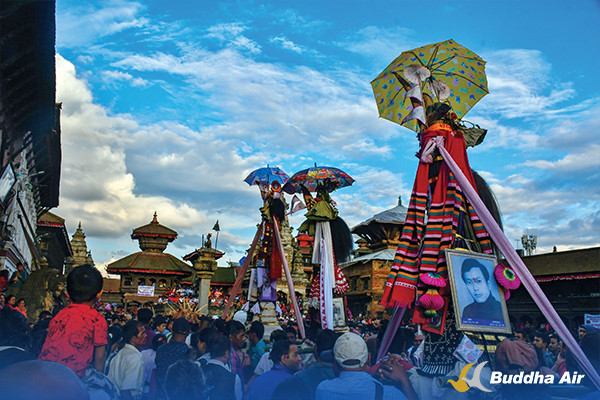
The chariot-pulling ceremony of Bhaktapur’s biggest festival, Biska Jatra, begins from Taumadhi Square. Devotional songs and prayers are performed every evening in the traditional rest houses around Taumadhi Square.
Dattatraya Square
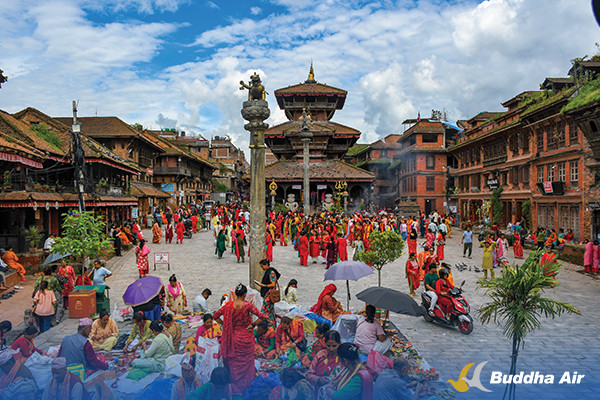
Newars of Nepalmandala worship Kumar before worshipping Ganesh & other gods & goddesses.
Dattatraya Square lies in the eastern part of Bhaktapur city. It is home to several heritage sites, including the Dattatraya Temple, Ganesh Temple, Bhimsen Temple, a pond, a museum, and the Peacock Window.
Dattatraya is worshipped as the three principal Hindu deities: Brahma, Vishnu, and Maheshwar. Brahma is the creator, Vishnu the preserver, and Maheshwar the destroyer.
In front of the pagoda-style Dattatraya Temple are statues of a pair of wrestlers, Jayamal and Pratap, who are believed to stand guard over the temple.
According to a popular story, King Yaksha Malla ordered the construction of this temple under the influence of traders who travelled from South India to Tibet for business.
Near Dattatraya Temple, ‘Pujari Math’ houses the metalwork and woodcarving galleries of the National Art Museum. With a single entrance ticket, visitors can see these two galleries as well as the National Art Museum in the Bhaktapur Durbar area. The museum contains collections of historical photographs, paintings, and sculptures.
The outer wall of ‘Pujari Math’ features the Peacock Window, an important archaeological heritage site. It features a peacock and dates back to the 15th century. ‘Pujari Math’ itself was built during the reign of King Yaksha Malla.
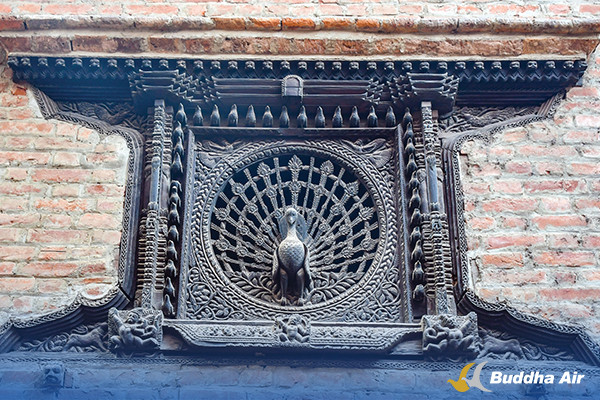
According to Hinduism, the peacock is the vehicle of Lord Kumar. He is regarded as the commander of the gods’ army. The Newar community attaches great importance to Kumar. While other Hindus generally worship Ganesh first when performing a religious ceremony, Newars of Nepal Mandala worship Kumar first, and only then worship Ganesh and other gods and goddesses.
Bhimsen Temple stands opposite the Dattatraya Temple. Bhimsen is regarded as the god of trade and commerce. The two-storey temple contains images of Bhimsen and Draupadi.
Behind Dattatraya Temple stands another temple dedicated to Wakupati Changunarayan. According to legend, the deity originated from a mound of rice. Later, King Balidev built the present two-storey temple.
The Peacock Shop
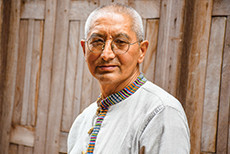 Near the Dattatraya Temple, opposite the Peacock Window, is ‘The Peacock Shop.’ This shop has been run since 1987 by retired associate professor of political science Ram Narayan Prajapati and his wife, Aparna. At first glance, it looks like a museum.
Visitors can watch live demonstrations of artworks being made from Nepali handmade paper. Inside the shop are displays of woodcarvings, metalwork, clay art, and stone carvings.
Contact: 9860749507
Must Experiences in Bhaktapur
Pottery Square
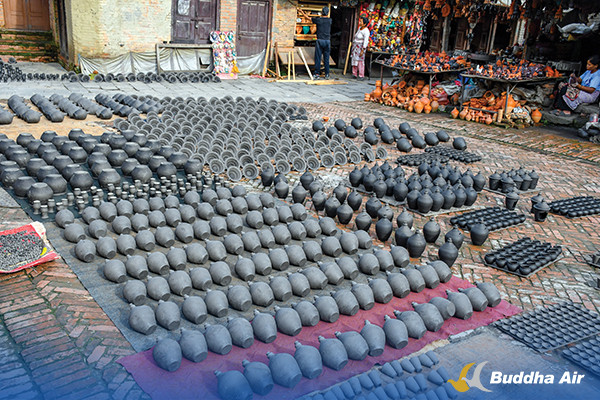
Visitors can also learn how to make clay pots here. They can take home the pots they make themselves.
The pottery-making profession is believed to be hundreds of years old. In Nepali society, clay vessels have traditionally been needed for everything from birth to death. Clay utensils are also considered healthy.
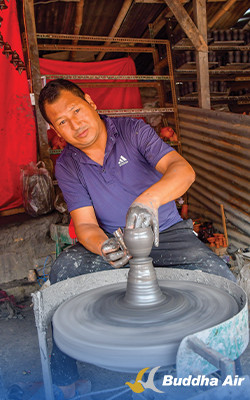
There is a Pottery Square south of Bhaktapur Durbar Square. Here, clay is shaped into different forms on a potter’s wheel.
In addition to everyday household utensils, potters make decorative items for homes, hotels, restaurants, offices, and public places.
Members of the Prajapati caste of the Newar community traditionally work with clay. In the past, pots were made by turning a traditional wooden wheel by hand. Today, modern electric wheels are used.
The sight of potters making, shaping, trimming, and drying their wares is fascinating. They also teach tourists how to make pottery. Tourists take home items such as pala (oil lamp) and khutruke (piggy bank) that they have made themselves.
Around 50 families in the Pottery Square area are engaged in this traditional occupation. Both women and men make pottery.
Times have changed, and plastic, iron, aluminium, brass, and steel products are now used more widely. Even so, demand for decorative items such as khutruke, dhupauro, pala, and flowerpots has not declined.
Octogenarian Artist
When will Bhaktapur Municipality honour artists such as Lalit Prajapati?
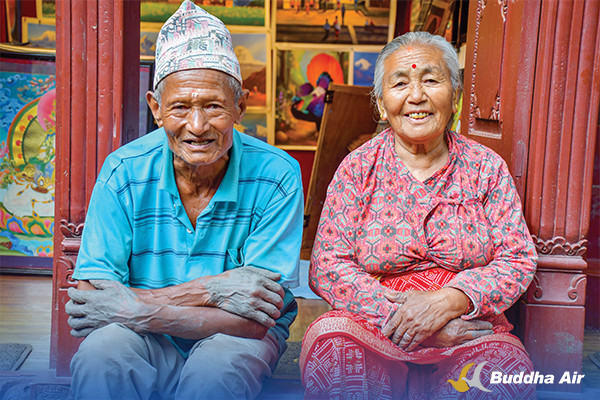
Visitors to Pottery Square can see an 82-year-old senior citizen making clay pots. Lalit Prajapati still uses his hands to turn a traditional wooden wheel, making khutruke (piggy banks) and water jars from clay. His 76-year-old wife, Krishnalaxmi, helps him.
In the past, he had to travel outside the city, dig up the clay himself, and bring it home. He would then pound it with a wooden mallet and knead it by trampling it with his feet until it became soft. Today, ready-mixed clay is available for purchase.
He learned to make pottery from his father when he was ten years old. By preserving this traditional skill throughout his life, he has become an inspiring example.
In his younger days, he would carry pots in a kharpan, a traditional carrying pole with baskets, and travel as far as Paachkhal in Kavre. He would exchange the pots for maize and bring the grain home. When he remembers those days now, they seem like a story even to him.
He takes pride in what he has earned through hard work.
“I have no problems with back pain or leg pain,” he says. “I will continue making pots as long as I can.”
Best wishes to the hardworking artist Lalit Prajapati!
Biska Jatra
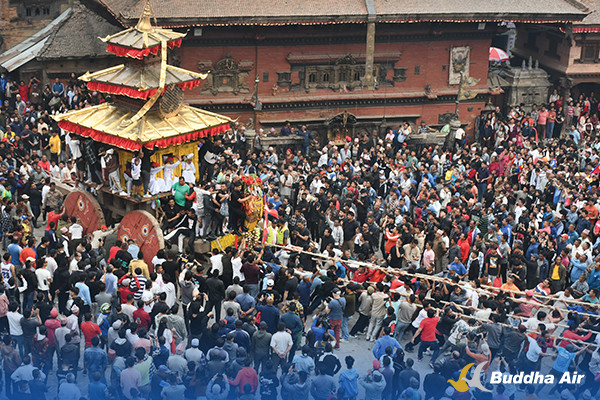
Biska Jatra is celebrated with great enthusiasm in Bhaktapur for nine days.
Biska Jatra is Bhaktapur’s biggest cultural festival. It is celebrated with great enthusiasm for eight nights and nine days. The main attractions of the festival are the raising of the lingo (ceremonial wooden pole), the flying of ceremonial flags, the chariot processions of Bhairav and Bhadrakali, and the tradition of lowering the lingo.
Biska Jatra is closely connected with Bhaktapur’s history, Newar culture, Tantric traditions, community spirit, and the welcoming of the New Year.
The festival begins on Chaitra 27 and ends on Baisakh 5 according to the Bikram Sambat calendar. It formally begins with the pulling of Bhairav’s chariot from Taumadhi Tole. Hundreds of people participate in pulling the three-storey chariot.
On the last day of Chaitra, a lingo without hands or arms is traditionally raised at Pottery Square and lowered on Baisakh 5. Similarly, a wooden lingo is raised at Bhelukhel on the last day of Chaitra. A long cloth flag is flown from the lingo. The lingo is lowered on the first of Baisakh, the first day of the New Year.
During Biska Jatra, people worship Bhairav, Bhadrakali, the Ashta Matrikas (Eight Mother Goddesses), and other deities. Guests are invited to homes and served a feast.
There is a popular belief that celebrating the festival with joy and enthusiasm brings peace and prosperity to the city, increases agricultural production, and protects people from disasters.
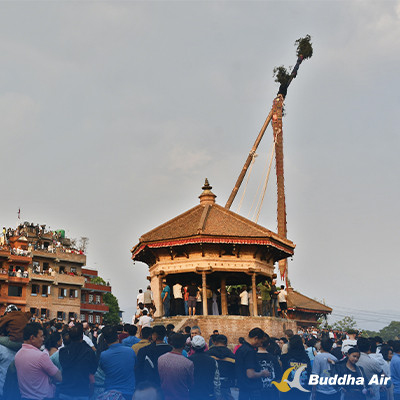
Overall, Biska Jatra strengthens the relationship between the local community, the deities, and nature.
There is a popular legend associated with the festival. According to the story, a princess of Bhaktapur was cursed. Her husbands began dying on the very night of their marriage.
As one husband after another died, princes grew afraid to marry her. Eventually, a brave prince agreed to marry her. He stayed awake throughout the night. At midnight, two snakes–a male and a female–emerged from the princess’s nostrils.
The prince immediately cut both snakes in half with his sword.
It is said that, from that time onward, the festival began to be celebrated by hanging flags from the lingo to commemorate the victory over the snakes.
Biska Jatra is associated with Bishwoketu, Bhairavnath, and Bhadrakali. The pair of flags flown from the lingo erected during Biska symbolize Bhairav and Bhadrakali. In Nepal Bhasa, the festival is called ‘Halipat.’ ‘Hali’ means ‘world’ and ‘pat’ means ‘flag.’ Thus, it means ‘the flag of the world.’ This flag is also considered an early precursor to the Nepali national flag.
Because the festival is celebrated around the time when the Sun is on the equator, it came to be known as the Bishwoketu Jatra. In Nepal Bhasa, it is called ‘Biska,’ while it is commonly known as Bisket Jatra.
Prof. Dr Purushottam Lochan Shrestha
Historian
Go Local
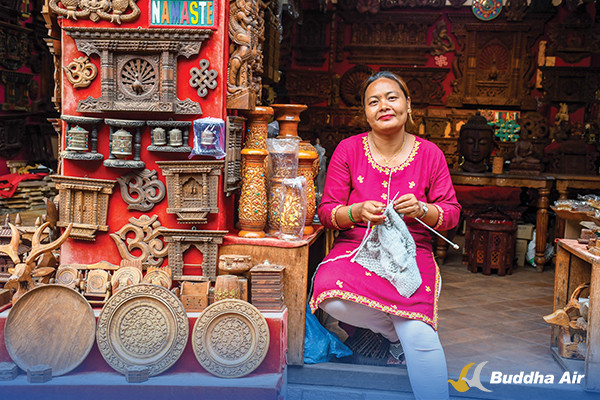
An initiative to promote products linked to local people’s pride, traditions, and identity.
The “Go Local” campaign has been launched in Bhaktapur to promote products that reflect local people’s pride, traditions, and identity. The campaign supports household and small-scale industries. It also helps preserve traditional skills and pass them on to the next generation.
The campaign is being carried out jointly by the Industry and Commerce Office, Bhaktapur; the Bhaktapur Cottage and Small Industries Association; and the Bhaktapur Tourism Development Committee. Tourists buy local products as souvenirs and also visit places where they are made.
The ‘Go Local’ campaign is promoting a wide range of products, including ‘ayla’ (traditional Newari liquor), woollen weaving, paper masks, woodcarving, carpets, rice and flour, Juju Dhau, beaten rice, handloom weaving, metalwork, Nepali handmade paper, felt products, Bhadgaule topi (Bhaktapur-style black caps), pottery, and other local products.
1. Taichin Chiura
Beaten rice, or ‘chiura,’ is a popular snack. Chiura made from the Taichin variety of rice is particularly tasty. There is a traditional chiura mill in Nagpokhari, Bhaktapur. The mill is run by tourism promoter Birendra Jati and his family.
Birendra’s father, Ganesh Lal, established the mill in 1983. They buy rice from farmers. After the rice is soaked, it is roasted over a fire heated to around 500 degrees and then pounded in a machine to make chiura.
He has also created a mini-museum to demonstrate the traditional method of making chiura. Family-stay accommodation is available here as well.
2. Terracotta House
Building a home is a dream for every Nepali. Sculptor Ramesh Pradhan has poured his creativity into his own home. In the Golmadhi neighbourhood, he has built a four-storey Terracotta House filled with artistic details.
On the ground floor, he has created windows inspired by the Fifty-Five-Window Palace. His house has 16 ‘tundals’ (ornamental wooden struts) decorated with sculptures of gods and goddesses. Sculptures of Garuda, as well as kings and queens, have also been placed around the house.
“I started building the house six years ago, and it will still take a few more years to complete,” says 50-year-old Pradhan. “I plan to turn it into a terracotta training center.”
3. Mask Art
Making masks is a traditional occupation of Chitrakars in the Newar community. In traditional dances, including the Navadurga dance, performers wear masks representing gods and goddesses. These days, masks are also used as decorations in homes, offices, hotels, and restaurants.
In Dugumla, Bhaktapur, Sanu Chitrakar makes masks every day. His wife, Radhika, helps him.
The masks are made using clay, jute sacks, Nepali handmade paper, cotton, and paint.
“The income does not match the amount of hard work involved,” says the 52-year-old. “That is why the younger generation is not attracted to this craft.”
Other Attractions
Siddha Pokhari
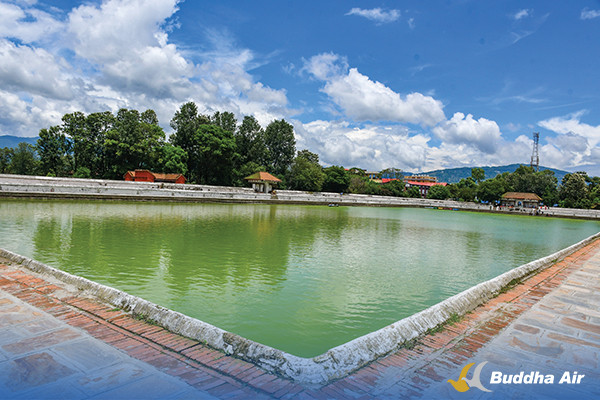
There are more than 3 dozen ponds in Bhaktapur. Siddha Pokhari is the largest among them. The pond is surrounded by a wall with gates on all four sides. It is also popularly known as “Indra Daha,” because King Indra Dev is said to have built it in Nepal Sambat 239.
Fish are raised in the pond, and boating facilities are also available. During Indra Jatra, a fair is held here throughout the night.
Hotels
There are only 55 hotels in Bhaktapur. Homestay facilities are also available, along with simple bed-and-breakfast accommodation. Staying in an artistically designed traditional building offers a unique experience.
The first tourist hotel in Bhaktapur was Hotel Bhaktapur, which is now operating at Chundevi Height.
Food
Bhaktapur is famous for its traditional cuisine. From simple local snack shops to modern restaurants, visitors can find Juju Dhau (the ‘king of yoghurt’), bara, chhoila, samay baji sets, haluwa papad swari rolls, jeri swari, thon (traditional rice beer), kulfi, and many other local delicacies.
That is not all. Restaurants in Bhaktapur also serve Nepali, Indian, Chinese, and Continental dishes.
Shopping
Shops selling a variety of goods can be found throughout the narrow streets of Bhaktapur. They offer food products, handicrafts, pottery, woodcarvings, masks, Juju Dhau, Bhadgaule topi (Bhaktapur-style black caps), Taichin chiura, hand-woven textiles, and other local products.
The shops also sell souvenirs made elsewhere, such as singing bowls and pashmina, alongside Bhaktapur’s traditional local products.


